Wallace Astrophysical Observatory
The George R. Wallace, Jr. Astrophysical Observatory is MIT's teaching and research optical observatory, located in Westford, Massachusetts. Established in 1971 and currently operated by the Planetary Astronomy Lab in the Department of Earth, Atmospheric, and Planetary Sciences, it is where MIT students learn to do observational astronomy with their own hands. I have served as the observatory director since 2013.
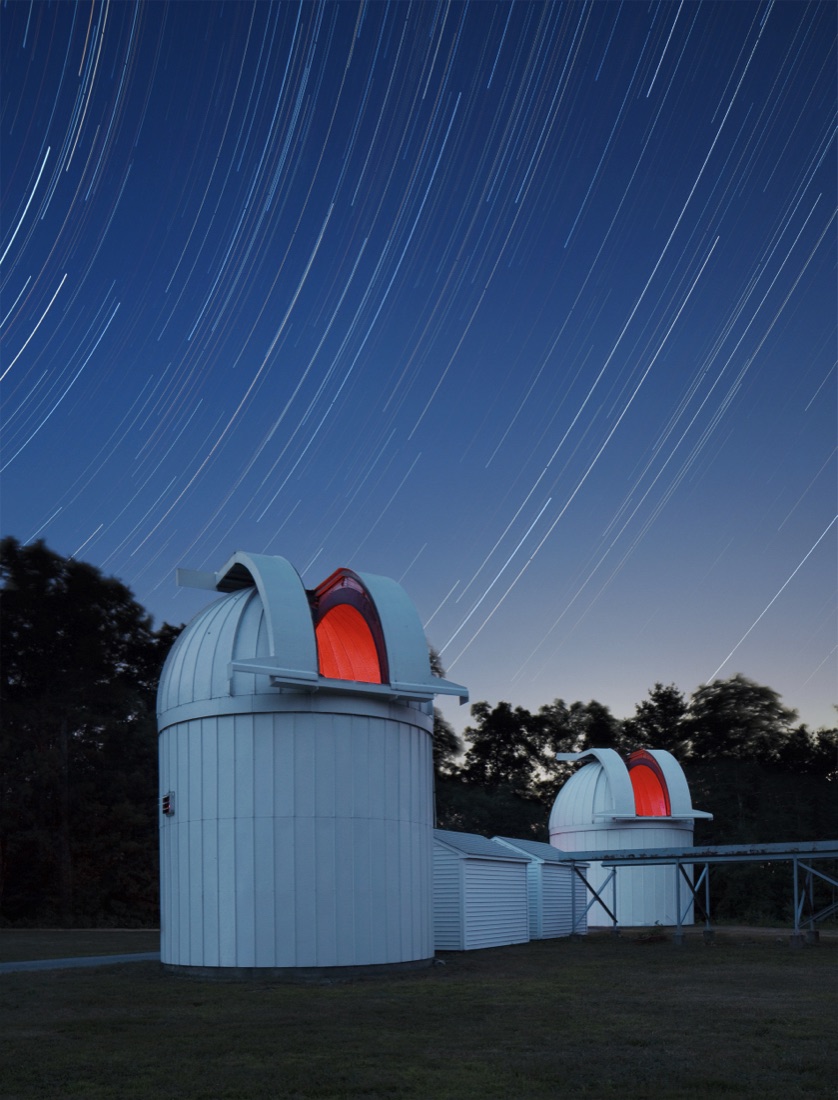
Telescopes & instruments
The observatory houses a pair of 24-inch (0.6 meter) telescopes — the Wallace and the Elliot — along with smaller telescopes, including four mounted 14-inch telescopes and a half-dozen portable 6-inch telescopes, with CCD cameras configured for photometry, astrometry, and spectroscopy.
Teaching
Wallace is a working classroom. Students in 12.409 (Hands-on Astronomy) and 12.410 (Observational Techniques of Optical Astronomy) travel out to Westford to plan their own observing runs, operate the telescopes, and reduce the data they collect — work that has led to a number of published student results.

Research
Research at Wallace centers on time-domain and solar-system astronomy:
- Stellar occultation prediction and timing.
- Lightcurves and astrometry of asteroids and Kuiper Belt objects.
- Characterization of near-Earth objects.
- Exoplanet transit photometry.
- Follow-up of transient events, including supernovae.
- Instrument development — new cameras and spectrographs.
Location & visiting
50 Groton Road, Westford, MA 01886 (42° 36′ 35″ N, 71° 29′ 04″ W). For schedules, directions, observing images, and more, see the official observatory site.